


University of Toronto Quarterly, Spring 2011 (Volume 80, Number 2)
First Fiction
By Cynthia Sugars
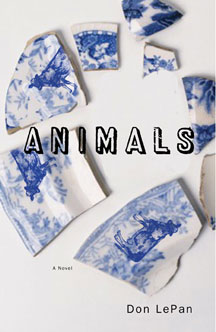
… Two books stand out among this year's first novels: Don LePan's Animals and Johanna Skibsrud's Giller Prize-winning The Sentimentalists. If you read nothing else from this year's batch of novels, however, read Animals. Few Canadian novels have been as powerful. Animals is a dystopian satire set somewhere around the late twenty-first century. However dramatic its subject matter, what ultimately makes this book so compelling is its subtlety. It is disturbing and gripping and relentlessly well told. Like Kazuo Ishiguro's best work (it reminded me in many ways of Ishiguro's Never Let Me Go, which was shortlisted for the 2005 Booker), it succeeds through its narrative restraint. It would be easy to go overboard in this type of world-gone-wrong dystopia but LePan never does. Instead, LePan delivers a tale that is at its most poetic at all the most jarring moments. There is an awful lyrical intensity, an ability to evoke a fragile state of innocence in the midst of a brutality that resides in people's attitudes as much as their actions, that makes Animals especially poignant. A great part of its power lies in what LePan manages to avoid; the narrative is suggestive rather than graphic or confrontational.
 This is not, however dystopian, some sort of apocalyptic nightmare. On the contrary, it is set in a world that has settled into a comfortably dysfunctional way of life, like the proverbial frog in the pot of gradually heated water. After decades of increasingly brutal but financially efficient advances, the livestock industry has imploded. Ever since ‘the great extinctions,’ as they have come to be remembered, the consumption of meat (chicken, beef, pork) has become a thing of the past. Worse, the rate of children born with some sort of extreme disability has skyrocketed, so much so that a new category has emerged: these sorts of children have come to be called mongrels. There is a sinister kind of duplicity about it all. The word mongrel is an umbrella term for a whole set of distinct problems, but even so, mongrels have slowly but surely become recognized as a wholly different type of species: as non-human. Categorical shorthand has been transformed into ontological difference. The differences aren't always obvious at birth, of course, but as a baby ages and it becomes clear that it is a mongrel rather than a human being, the creature must be handled differently, left to sleep on the floor, fed different types of food and no longer at the dinner table, dressed differently. In other words, it must be recognized for what it really is: a family pet. Loveable, perhaps, and eager to please, but clearly incapable of the sorts of development that one would expect to see in a child.
That might not in itself be so bad except that times are tough. The bottom has fallen out of the welfare state and people are edgy. ‘[H]ow could you justify putting the resources - the time as well as the money - into improving their lot when so many of the fully human were in such desperate straits?’ Why should so many of people's hard-earned tax dollars go to support creatures that, even with the most expensive medical help, can never live anything close to meaningful lives? It all sounds absurd, but in an age when ‘drill, baby, drill’ can become a major campaign slogan, nothing is impossible. Eventually, like Jonathan Swift's darkly satiric A Modest Proposal, a solution emerges. Those mongrels that families have not chosen to adopt as pets, which have instead been handed over to institutions along the lines of the SPCA, could be harvested. It’s a tricky transition, and at first there is a chorus of voices raised against the idea, but eventually the protests die out and, with the help of scientific studies that turn out to have been funded by companies who hope to establish themselves in the industry, public opinion is slowly but surely brought onside. The whole initiative needs to be handled properly, of course. A new name has to be invented, the way ‘beef’ had once been used as a reference for cows and 'pork' for pigs. Mongrels who are to be harvested come to be known as ‘chattels’ (chattel pens being their final destination); their meat is referred to as ‘yurn’ in North America, or ‘fland’ in Britain and Australia. From there it is only a minor leap of the imagination to the obvious next step: if demand outstrips supply, industrial-level chattel farming is an obvious answer. People might feel squeamish about eating mongrel, but once it has been rebranded, most are surprised by how easily they adapt.
All of this is background to the story itself, which is structured as two narratives. The tension between them is a large part of what animates the novel. The first, like the well-intentioned and endlessly rational narrative voice in Swift's Modest Proposal, is chilling for the calm tone of philosophical detachment with which it relates this broader social and economic history, patiently outlining the specific political and economic hurdles that this new industry had to cross, such as the long time (and therefore the high cost) involved in growing chattels until they have enough meat that they are profitable to harvest, the moral quandaries this created for people who did not always want to be entirely honest with themselves about the choices they were making, and so on. The second narrative, which forms the real core of the novel, is just the opposite: the intensely personal story of Sam, a young mongrel left on the doorstep of a well-to-do family by a desperately poor single mother who, laid off from her latest job, can no longer pay the rent or care for her other children and Sam as well. And this well-to-do family, the Stinsons, do take Sam in, the way any family with small children might adopt a stray kitten that appears on their doorstep. The parents say no at first, but their daughter Naomi is insistent. “‘But Daddy, I told him . . . I shouldn't have, but I did . . . I told him he'd be safe, I would take care of him. It was a promise.’” The poignant lyrical fragility with which LePan evokes Naomi's and Sam's relationship is ultimately what makes the novel so memorable. Lines from Winnie the Pooh and Where the Wild Things Are, which Naomi reads to Sam again and again, are woven throughout the story in ways that bring Sam's inner world to life.
Things go reasonably well until Naomi realizes with a shock that Sam has learned to speak. He's not a mongrel at all, she realizes, he's just deaf! He has been incorrectly classified, but now that she knows, now that all of this is clear, he can be adopted into the family as a child rather than a pet, one with a disability, it is true, but a human being all the same. Except that when she tells her mother (their father is away at the time), the news touches a nerve and everything unravels with a horrible inevitability. Not only can Naomi's mother not accept the news, she can no longer live with this creature in the house. Driven by the ghosts in her own psychic dark corners, Naomi's mother, Carrie, decides to take matters into her own hands, to make the sort of difficult choices that a responsible parent has to make if she’s really looking out for her child's best interests, as she puts it to herself. Mongrel pets cannot legally be reclassified as chattels but there is a black-market industry that can take care of these things. The events that unfold are all the more harrowing for both the restraint with which LePan handles them and the brilliance with which he manages to evoke the small, fragile, stubborn innocence of Sam's world, unable to make himself heard to anyone who cares and taking useless comfort in reciting lines from his favourite books, like the story of Max, who tells the wild things to stop and then suddenly wanted to be where someone loved him best of all, and who ‘had sailed back to his very own room with the supper his mother had made waiting for him and it was still warm, could it be like that?’
The title, Animals, plays out on several levels: the absence of livestock as a result of systematic industrial abuses and the subsequent identification of mongrels as animals, but also the ability of people to behave as less than human (in ways that no animal ever actually would). This applies to the people who are most directly involved in this new industry, of course, but LePan's slyest satirical point is the even greater extent to which it applies to our more general capacity for complicity, our ability not to think too carefully about the wretched practices and conditions that our own lives have helped to foster. It is not in any way a new point, of course. John Ruskin said the same thing back in the nineteenth century. But Animals triumphs by registering these ideas with an immediacy and satiric edge that give an altogether new force to familiar ideas.
This is not, however dystopian, some sort of apocalyptic nightmare. On the contrary, it is set in a world that has settled into a comfortably dysfunctional way of life, like the proverbial frog in the pot of gradually heated water. After decades of increasingly brutal but financially efficient advances, the livestock industry has imploded. Ever since ‘the great extinctions,’ as they have come to be remembered, the consumption of meat (chicken, beef, pork) has become a thing of the past. Worse, the rate of children born with some sort of extreme disability has skyrocketed, so much so that a new category has emerged: these sorts of children have come to be called mongrels. There is a sinister kind of duplicity about it all. The word mongrel is an umbrella term for a whole set of distinct problems, but even so, mongrels have slowly but surely become recognized as a wholly different type of species: as non-human. Categorical shorthand has been transformed into ontological difference. The differences aren't always obvious at birth, of course, but as a baby ages and it becomes clear that it is a mongrel rather than a human being, the creature must be handled differently, left to sleep on the floor, fed different types of food and no longer at the dinner table, dressed differently. In other words, it must be recognized for what it really is: a family pet. Loveable, perhaps, and eager to please, but clearly incapable of the sorts of development that one would expect to see in a child. That might not in itself be so bad except that times are tough. The bottom has fallen out of the welfare state and people are edgy. ‘[H]ow could you justify putting the resources - the time as well as the money - into improving their lot when so many of the fully human were in such desperate straits?’ Why should so many of people's hard-earned tax dollars go to support creatures that, even with the most expensive medical help, can never live anything close to meaningful lives? It all sounds absurd, but in an age when ‘drill, baby, drill’ can become a major campaign slogan, nothing is impossible. Eventually, like Jonathan Swift's darkly satiric A Modest Proposal, a solution emerges. Those mongrels that families have not chosen to adopt as pets, which have instead been handed over to institutions along the lines of the SPCA, could be harvested. It’s a tricky transition, and at first there is a chorus of voices raised against the idea, but eventually the protests die out and, with the help of scientific studies that turn out to have been funded by companies who hope to establish themselves in the industry, public opinion is slowly but surely brought onside. The whole initiative needs to be handled properly, of course. A new name has to be invented, the way ‘beef’ had once been used as a reference for cows and 'pork' for pigs. Mongrels who are to be harvested come to be known as ‘chattels’ (chattel pens being their final destination); their meat is referred to as ‘yurn’ in North America, or ‘fland’ in Britain and Australia. From there it is only a minor leap of the imagination to the obvious next step: if demand outstrips supply, industrial-level chattel farming is an obvious answer. People might feel squeamish about eating mongrel, but once it has been rebranded, most are surprised by how easily they adapt. All of this is background to the story itself, which is structured as two narratives. The tension between them is a large part of what animates the novel. The first, like the well-intentioned and endlessly rational narrative voice in Swift's Modest Proposal, is chilling for the calm tone of philosophical detachment with which it relates this broader social and economic history, patiently outlining the specific political and economic hurdles that this new industry had to cross, such as the long time (and therefore the high cost) involved in growing chattels until they have enough meat that they are profitable to harvest, the moral quandaries this created for people who did not always want to be entirely honest with themselves about the choices they were making, and so on. The second narrative, which forms the real core of the novel, is just the opposite: the intensely personal story of Sam, a young mongrel left on the doorstep of a well-to-do family by a desperately poor single mother who, laid off from her latest job, can no longer pay the rent or care for her other children and Sam as well. And this well-to-do family, the Stinsons, do take Sam in, the way any family with small children might adopt a stray kitten that appears on their doorstep. The parents say no at first, but their daughter Naomi is insistent. “‘But Daddy, I told him . . . I shouldn't have, but I did . . . I told him he'd be safe, I would take care of him. It was a promise.’” The poignant lyrical fragility with which LePan evokes Naomi's and Sam's relationship is ultimately what makes the novel so memorable. Lines from Winnie the Pooh and Where the Wild Things Are, which Naomi reads to Sam again and again, are woven throughout the story in ways that bring Sam's inner world to life. Things go reasonably well until Naomi realizes with a shock that Sam has learned to speak. He's not a mongrel at all, she realizes, he's just deaf! He has been incorrectly classified, but now that she knows, now that all of this is clear, he can be adopted into the family as a child rather than a pet, one with a disability, it is true, but a human being all the same. Except that when she tells her mother (their father is away at the time), the news touches a nerve and everything unravels with a horrible inevitability. Not only can Naomi's mother not accept the news, she can no longer live with this creature in the house. Driven by the ghosts in her own psychic dark corners, Naomi's mother, Carrie, decides to take matters into her own hands, to make the sort of difficult choices that a responsible parent has to make if she’s really looking out for her child's best interests, as she puts it to herself. Mongrel pets cannot legally be reclassified as chattels but there is a black-market industry that can take care of these things. The events that unfold are all the more harrowing for both the restraint with which LePan handles them and the brilliance with which he manages to evoke the small, fragile, stubborn innocence of Sam's world, unable to make himself heard to anyone who cares and taking useless comfort in reciting lines from his favourite books, like the story of Max, who tells the wild things to stop and then suddenly wanted to be where someone loved him best of all, and who ‘had sailed back to his very own room with the supper his mother had made waiting for him and it was still warm, could it be like that?’The title, Animals, plays out on several levels: the absence of livestock as a result of systematic industrial abuses and the subsequent identification of mongrels as animals, but also the ability of people to behave as less than human (in ways that no animal ever actually would). This applies to the people who are most directly involved in this new industry, of course, but LePan's slyest satirical point is the even greater extent to which it applies to our more general capacity for complicity, our ability not to think too carefully about the wretched practices and conditions that our own lives have helped to foster. It is not in any way a new point, of course. John Ruskin said the same thing back in the nineteenth century. But Animals triumphs by registering these ideas with an immediacy and satiric edge that give an altogether new force to familiar ideas. SF Weekly (San Francisco), November 10, 2010
Just Before It All Went Kablooey
By Paul M. Davis
Modern society is so intractably fucked that it's a fair question whether we still need the dystopian novel. Many of the most despairing science fiction visions, such as Philip K. Dick's fever-dreams of capitalist dictatorships and surveillance states, could pass for contemporary realism. For a modern-day dystopian novel to really hit, it has to go much further than its predecessors while maintaining a sense of eerie plausibility. Author and artist Don LePan's debut, Animals, fits the bill, presenting a vision of Earth 100 years from now suffering from mass extinction because of factory farming and overuse of antibiotics. The unforgiving world he conjures is both horrifying and plausible: Disabled humans are farmed for meat, while the lucky ones are kept as pets. The book's protagonist, Sam, is one of these fortunate-yet-damned, a 10-year-old deaf child who lives for the amusement of his owners. Far from a flight of fancy, LePan's Brave New World by way of Michael Pollan is given added resonance in our age of swine flu outbreaks and egg producers who casually sell salmonella to their customers. And while it's a premise that could easily devolve into a dry treatise on animal rights, LePan keeps things moving, with a narrative by turns chilling and stomach-churning but always keenly observed.
A Novel Indictment of Factory Farming
By Thrity Umrigar
Some books we love; others we admire. Don LePan’s debut novel, Animals, falls firmly in the second category.
In an unusually candid author’s afterword, LePan confesses that his intention in writing the novel was to draw attention to the barbarity of the practice of factory farming. Not that we need the afterword. Although set 100 years into the future, the entire novel is a thinly disguised rant about the horrors of contemporary large-scale farms where animals are raised in inhumane conditions. The central conceit involves the coming of an era of great extinctions when all the animals that humans once consumed have been wiped out. Society has created a category of sub-humans, known as the mongrels, those who are “defective’’ in some way. To meet their craving for meat, humans have started to fatten and then consume the mongrels, often by the time they are 10 or 11 years old.There are not too many authors who can pull off a novel that is essentially about adults feeding on their human young. But LePan has an affectless, dispassionate writing style, and he convincingly paints a picture of a callous, self-serving, dystopian world. The novel operates at two levels — first, there is the regular narrative, about Sam, a young mongrel abandoned by his destitute mother. Sam is taken in by Carrie and Zayne Stinton after their daughter Naomi finds him on their doorstep and begs her parents to “adopt’’ him as a pet. But Carrie is never quite at ease with Naomi’s growing attachment to Sam and commits an impulsive act that has lasting reverberations. Sam’s eventual plight, of course, is meant to symbolize the desperate plight of animals at the large agro-industrial farms of today.Not trusting his reader to glean the symbolic meaning of his narrative, LePan continually interrupts this main story line with a parallel narrative, which purports to be a scholarly, historical overview of life in the aftermath of the great extinctions, a description of the willfully blind ways in which society operates, and the multitude of everyday cruelties it afflicts upon its most powerless members.As you’ve probably gathered by now, Animals ain’t exactly summer beach reading. Indeed, LePan doesn’t seem all that interested in standard literary techniques such as plot and character development. The story, such as it is, exists only to illuminate the message of the book. This is a political tract disguised as a novel and LePan offers no apologies for this.And yet, almost despite itself, the novel achieves moments of grace. LePan has an astute understanding of the contradictions and weaknesses of human nature. His portrayal of the weak, confused Zayne and the indomitable Carrie is particularly trenchant. And the scenes of Sam in the pen where the mongrels are taken to await slaughter are harrowing. Despite his inability to speak, Sam’s humanity comes across to us as clearly as it does to Naomi, and so the ending packs an emotional wallop.There is something admirable about a novel that does not want to be loved, that simply wants to be read and discussed. Animals may not be a book you recommend to your best friends as a must-read. But it will most certainly make you look at that steak on your dinner plate a little differently.
Thrity Umrigar is the author of a memoir and four novels, including the best-selling “The Space Between Us,’’ and her recent novel, “The Weight of Heaven.’’
Publishers Weekly: June 2010
Animals
At the center of this dystopian novel lies a philosophical premise: that the line between human and animal is too unclear to justify inhumane treatment of the latter--whether pet or farm animal. In a twenty-second century America, a combination of mass extinction and economic hardship has led people to look for an alternate source of meat: disabled human beings, stripped of their humanity, who are either kept as pets or farmed, with cruel efficiency, as food. Sam is one such person, a deaf child abandoned by his mother and adopted as a pet. The "found manuscript" that tells his story, and the accompanying scholarly commentary, paint a convincing picture of moral decline and ethical inconsistency on a devastating scale. Though at times heavy-handed, Animals nonetheless has the moral clarity and narrative drive of the best of the genre. LePan's vision is extreme, and though he focuses more on the evils of factory farming than on vegan evangelism, some may find it off-putting. But even those who might disagree with his thesis will be compelled by the implications of this well-plotted and formally audacious tale.
Animals
At the center of this dystopian novel lies a philosophical premise: that the line between human and animal is too unclear to justify inhumane treatment of the latter--whether pet or farm animal. In a twenty-second century America, a combination of mass extinction and economic hardship has led people to look for an alternate source of meat: disabled human beings, stripped of their humanity, who are either kept as pets or farmed, with cruel efficiency, as food. Sam is one such person, a deaf child abandoned by his mother and adopted as a pet. The "found manuscript" that tells his story, and the accompanying scholarly commentary, paint a convincing picture of moral decline and ethical inconsistency on a devastating scale. Though at times heavy-handed, Animals nonetheless has the moral clarity and narrative drive of the best of the genre. LePan's vision is extreme, and though he focuses more on the evils of factory farming than on vegan evangelism, some may find it off-putting. But even those who might disagree with his thesis will be compelled by the implications of this well-plotted and formally audacious tale.
The Globe and Mail, Saturday October 24, 2009
Getting to the meat of the matter
by Jim Bartley
Don LePan's book is a spot-on analysis of the human capacity to reconcile sentiment with savagery
This summer, I enjoyed a grilled mutton lunch next to a Bosnian sheep meadow. I had watched my lunch trot out on its daily outings to the same meadow. Later, I had watched my friends lead the animal to a grassy plot behind their house. There was a moment of struggle, blood, then speedy death. Inevitably, it led to comparisons with the flesh I eat in Canada and the news from factory farms. Like many, I'm good at suppressing such thoughts. Then Don LePan's novel turned up on my doorstep.
It's the near future. Near enough that there are still things like rusty Hondas belonging to inner-city moms who wonder how they'll keep the kids fed, let alone a hungry pet. Tammy has four children and one mongrel: Sam. Sam is not a dog. In this world, mongrels form a subset of humans. Some families are torn about what to do with their mongrel kids. Sam, luckier than some, ate people food at a people table until he became too much of an embarrassment. Now, he eats pet food by himself in a corner of the kitchen. His food may even contain ground-up mongrel – but moms try not to think about that. The mongrel content in Sam's food is the result of a global shortage of protein, because all the cows, sheep, pigs, chickens and other farmed creatures are extinct. Sam looks and thinks like a human (we observe sometimes through his viewpoint), but he can't speak, or care for himself to the usual human standard. He can seem, even to his own family, more animal than person. In LePan's dystopic allegory, he ranks well below even Aldous Huxley's menial Epsilons in value and utility. Where compassion for mongrels still hangs on is in the moms, but we can predict who gets sacrificed in a crisis.Tammy, her household economy in free fall, is forced to make a terrible choice: Keep Sam and jeopardize her family's health and future, or place him elsewhere. With overdue rent bearing down on her, she and the kids skip town early one morning, leaving Sam wrapped in blankets at the door of well-to-do neighbours. Sam's story alternates with extensive backstory from his brother Broderick, who offers the “big picture” of how the world has come to such a pass. The scenario is nightmarish. As the 21st century advanced, mongrel births, blamed on pollution, mushroomed to one out of five. With food animals extinct from rampant drug dosing and filth-induced epidemics, an orchestrated ethical shift led to mongrels being redefined as “chattels” – edible property. Technology and commerce exploited the new and stable protein source. Unable to reproduce, most food mongrels were cloned. The residue were, are, creatures like Sam: kids with mothers, yet a legal hair's breadth from becoming meat. This is an angry book, its characters always in service to the anguished message. As an analysis of the human capacity to reconcile sentiment with savagery, it's spot on: psychologically incisive, admirably disquieting. Still, the novel's challenges are not always productive. Broderick himself anticipates readers' response: “I have no doubt spent far too long on the history and the economics … when I know that what many of you are interested in is the narrative of individual lives.” He's right. Part of the bog-down is the frequent footnotes, up to a half-page long, filled with textbook-ish historical detail, cultural analysis, market tracking and so on. The book's fictional meat (or tofu) is crowded by editorial starch. Animals will leave some readers lagging, but they should persist. LePan may openly grind his axe, but what makes the book powerful is just how keenly that axe cuts through our ethical hypocrisy. Jim Bartley is The Globe and Mail's first-fiction reviewer.
The Montreal Review of Books—fall 2009
Animals
by Dimitri Nasrallah
For his debut novel Animals, Broadview Press founder Don LePan has written a speculative fiction that looks into our not-so-bright future. LePan's vision is stark: all the farmable animals we know are dead, and so we've begun to eat our own. The civic and capitalist forces that have previously ground out livestock now work together to demote a sub-class of human into food. These "mongrels," incidentally, have either too many or too few chromosomes.
Animals is fearless and cynical that way, and reading it will make you think twice before pulling that steak out of the freezer for tonight's dinner. The premise alone is enough to make a compelling case for rethinking how our meat is raised and treated. But the narrative has multiple levels, and LePan is very keen to make his argument irrefutable. Though he ultimately succeeds, he sometimes overshoots his mark along the way.In Animals, there is the story, which involves a young mongrel named Sam Clark, and then there is the story of the story, in which his older brother Broderick Clark recounts the conditions that make Sam's odyssey so speculatively futuristic. Sam is the mongrel society wants to eat. He is the emotional heart of the story; he's our front line in this world of the future. His brother Broderick is the novel's head.The novel is delivered as two manuscripts. The first is the autobiographical writing of writer Naomi Okun, who as a girl discovered the toddler Sam bundled up on her porch after his mother could no longer afford to keep him. The second features Broderick's extensive essay on the industry and legalities of mongrel farming, and the details of how the future world could have devolved to such a state. There are copious footnotes added to the second manuscript. Broderick obviously knows a lot about the mass-farming industry, as does LePan, and the reader can't help but feel that the character is little more than a mouthpiece for the author.It's not as if these industry specifics are strictly necessary for the enjoyment of the central story. Sam's life as Naomi's pet, and the divisions his presence exposes in the attitudes of her parents carry manifest social implications about what it means to be human in an age when a definition can turn a human into food. Here, LePan's storytelling skills are on full display and the narrative brims with tension.So it's with some reluctance that the reader continuously breaks away from this more successful half of the novel to read the university-style lecture delivered by Broderick. The driving purpose behind all speculative fiction is ultimately the blend of story and argumentation. In Animals, that blend is denied. LePan has charged Sam with providing the fiction, while his brother has been handed the responsibility of doing the speculation.Despite its structural issues, Animals is a brave and frequently fascinating debut novel, wrought with painful choices, harrowing journeys, and a deep passion for its subject matter. LePan has proven admirably that he has the chops to write a successful novel, or a work of non-fiction on the future of meat. One hopes that next time he won't shoehorn them both into the same book. Dimitri Nasrallah is a novelist and music journalist.
The Montreal Gazette, The Victoria Times-Colonist, The National Post, The Saskatoon Star-Phoenix (January 2, 10, 23 and February 6, 2010 respectively)
Novel Depicts a Time When Monsters are all too Human
by Anne Chudobiak
When Margaret Atwood wrote The Handmaid's Tale, she didn't take kindly to the label of science fiction, eventually telling the Guardian, "Science fiction has monsters and spaceships; speculative fiction could really happen." Apply her definitions to Nanaimo writer Don LePan's first novel, and it becomes clear why Animals is so disturbing: the monsters are all-too-recognizably human.
Animals depicts a terrifying future not too many generations down the road. Because of factory farming, most of the animals we use for food have gone extinct: "The diseases wouldn't have spread so quickly if the creatures hadn't been packed thousands upon thousands together in feedlots."
Tofu is still readily available, and people do eat it, but not happily. Its reputation as a protein source has been tarnished by years of negative campaigning by the meat and dairy industries. The competitors are gone, but their message -- that soy poses some kind of health danger -- lives on.
The solution stems from another societal change. More babies are being born with abnormalities. But the economy has collapsed, and where once there were insufficient resources to help people with such problems, there is now a near-total lack of desire. Children with special needs are simply seen as belonging to another species called "mongrel." The lucky ones are raised as pets; unlucky ones are consigned to feedlots. Children with special needs are the new meat.
The story revolves around Sam, a boy who is mistaken for a mongrel and abandoned by his family.
Animals is a novel, yes, but it is also an unabashed call to arms for the animal-rights movement. It has almost as much in common with Eric Schlosser's Fast Food Nation as it does with The Handmaid's Tale. There is a lot of fact in this fiction, some of it inelegantly inserted as long-winded, scholarly footnotes: "Between 1900 and 1950 meat became relatively more expensive; the prices of flour and sugar went up by about four times, while the price of hamburger went up by about six times. Between 1950 and 2000, the half-century in which factory farming took over, that pattern was reversed."
It's as though LePan, 55, founder of an academic press and son of novelist Douglas LePan (whose 1964 book The Deserter beat out Margaret Laurence's The Stone Angel for a Governor General's Award), is channelling two very different literary lineages: scholarly and fictional. Unfortunately, Don LePan doesn't know his own strengths. If he had kept with Sam's enchantingly horrifying orphan's tale, I might have been shamed into changing my meat-eating ways. But the scholarly interruptions detract from the story, weakening its emotional impact and its message that our choices at the grocery store can relieve or engender unconscionable suffering
Note: This review has appeared under various headlines:
A Stomach-Turning Future (Montreal Gazette)
Long Footnotes Spoil Good Story (Times-Colonist)
A Dystopian Vision, Complete With Footnotes (National Post)
Novel Depicts a Time when Monsters are all Too Human (Saskatoon Star-Phoenix)
Animals depicts a terrifying future not too many generations down the road. Because of factory farming, most of the animals we use for food have gone extinct: "The diseases wouldn't have spread so quickly if the creatures hadn't been packed thousands upon thousands together in feedlots." Tofu is still readily available, and people do eat it, but not happily. Its reputation as a protein source has been tarnished by years of negative campaigning by the meat and dairy industries. The competitors are gone, but their message -- that soy poses some kind of health danger -- lives on.The solution stems from another societal change. More babies are being born with abnormalities. But the economy has collapsed, and where once there were insufficient resources to help people with such problems, there is now a near-total lack of desire. Children with special needs are simply seen as belonging to another species called "mongrel." The lucky ones are raised as pets; unlucky ones are consigned to feedlots. Children with special needs are the new meat.The story revolves around Sam, a boy who is mistaken for a mongrel and abandoned by his family.Animals is a novel, yes, but it is also an unabashed call to arms for the animal-rights movement. It has almost as much in common with Eric Schlosser's Fast Food Nation as it does with The Handmaid's Tale. There is a lot of fact in this fiction, some of it inelegantly inserted as long-winded, scholarly footnotes: "Between 1900 and 1950 meat became relatively more expensive; the prices of flour and sugar went up by about four times, while the price of hamburger went up by about six times. Between 1950 and 2000, the half-century in which factory farming took over, that pattern was reversed." It's as though LePan, 55, founder of an academic press and son of novelist Douglas LePan (whose 1964 book The Deserter beat out Margaret Laurence's The Stone Angel for a Governor General's Award), is channelling two very different literary lineages: scholarly and fictional. Unfortunately, Don LePan doesn't know his own strengths. If he had kept with Sam's enchantingly horrifying orphan's tale, I might have been shamed into changing my meat-eating ways. But the scholarly interruptions detract from the story, weakening its emotional impact and its message that our choices at the grocery store can relieve or engender unconscionable sufferingNote: This review has appeared under various headlines:
A Stomach-Turning Future (Montreal Gazette)
Long Footnotes Spoil Good Story (Times-Colonist)
A Dystopian Vision, Complete With Footnotes (National Post)
Novel Depicts a Time when Monsters are all Too Human (Saskatoon Star-Phoenix)
Canadian Literature, Summer 2011 (#209)
Animal Laughter
By Clint Burnham
...Don LePan’s Animals is a manifesto on animal rights under the guise of a science fiction-ish “found” manuscript, while Charles Demers’ Prescription Errors draws on the author’s stand-up comedy background and psychogeographies, as well as featuring a DIY researcher character. Demers’ is the more successful of the two efforts, but perhaps we can learn more from LePan’s failure.
Why do I think Animals fails? For two reasons: first of all, it never provides a compelling reason for why it switches back and forth between fiction and manifesto. Thus we have the narrative of Sammy, a deaf child born sometime in the future when such deficient children are labelled “mongrels” and treated as some combination of pets and food animals. Sammy is abandoned by his noble working-class mother, Tammy, who mistakenly thinks that the yuppie family of Naomi (complete with ball-busting mother Carrie and henpecked painter-father Zayne) will provide him with a good home. Of course Naomi is a wonderful child—she ends up being a creative writing professor who writes this found manuscript—but equally inevitable is that, once we’ve endured the treacle of Naomi and Sammy’s limited p.o.v., Carrie will come to abandon Sammy to the Auschwitz-like factory farms that populate this ponderous allegory. Interpolated with this fiction that has all the subtlety of a PETA parable for pre-schoolers is an even more heavy-handed series of historical notes on how the twenty-first-century global extinction of food animals led to the breeding of human mongrels for that purpose. The problem is, of course, that these notes—by a now-grown-up member of Sammy’s first family—are as one-dimensional and lackluster a piece of writing as is the fiction among which they’re woven. What is finally so remarkable about these pseudo-non-fictions is their own lack of confidence:I started earlier to tell you something of the history of the mongrels and of the chattels—and, before that, of the farm animals. I’m going to carry on in that vein now, as I will continue doing here and there throughout these pages. I guess I should make clear, though, that if none of this interests you—if what you really want is to find out about Sam and Naomi, find out how it ends and not hear all the whatnot about politics and the rest of it—that’s perfectly all right.
Now, if only the novel had provided the option of not reading the story of Sam and Naomi as well.

